
Ukraine Taxing OnlyFans Creators: The 2026 Legal & Tax Crossroads

Leo Vance
Published: Oct 15, 2026 • 17 min read
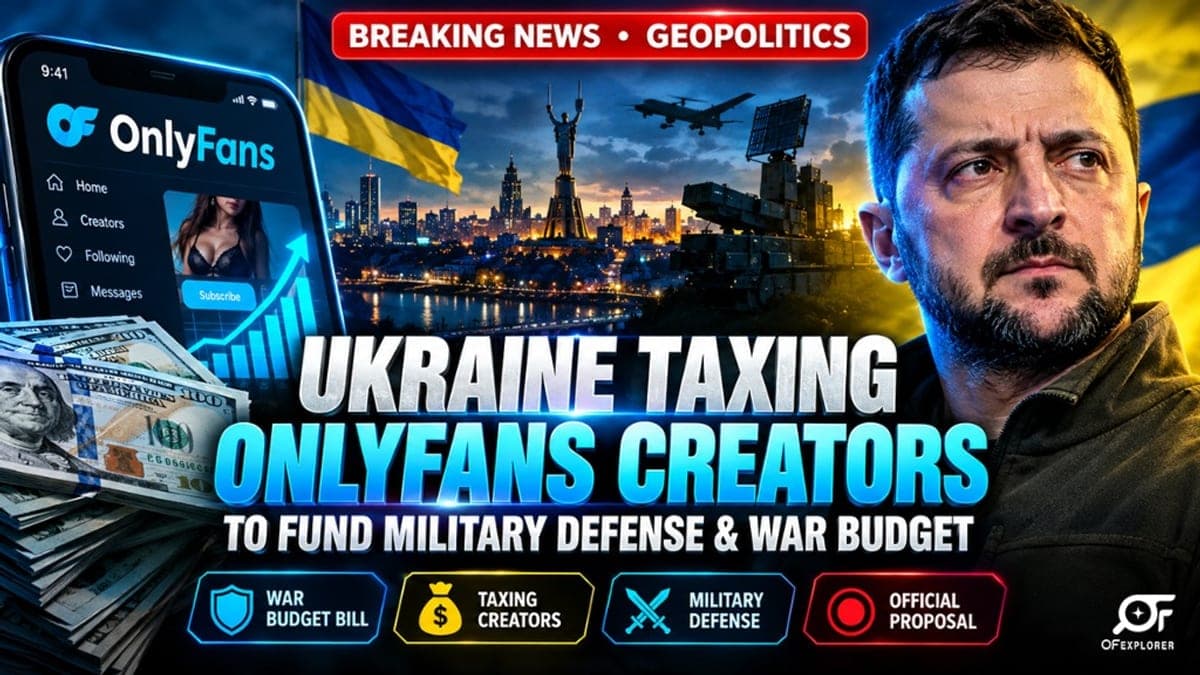
The intersection of digital subscription platforms, cross-border fiscal oversight, and post-Soviet criminal jurisprudence has created an extraordinary legal crossroads in Eastern Europe: the state of Ukraine actively taxing OnlyFans creators while maintaining criminal prohibitions against adult content creation.
Across 2024, 2025, and 2026, the State Tax Service of Ukraine (Державна податкова служба України - DPS) and the parliamentary committee on finance, taxation, and customs policy have intensified enforcement campaigns requiring Ukrainian content creators to declare all foreign-source earnings originating from London-based Fenix International Limited (the corporate parent of OnlyFans). At the same time, law enforcement bodies—including the National Police and the Bureau of Economic Security (Бюро економічної безпеки - BEB)—continue to initiate criminal proceedings under Article 301 of the Criminal Code of Ukraine, which penalizes the manufacture and distribution of pornographic materials.
This investigative legal analysis unpacks the factual, statutory, and judicial realities of Ukraine taxing OnlyFans creators in 2026, examining the 23% combined statutory tax baseline, concrete judicial precedents involving bilateral UK–Ukraine tax information exchanges, the newly adopted Law No. 4903-IX digital platform reporting framework, and the ongoing parliamentary debate surrounding decriminalization.
1. Executive Overview: The Ukrainian Institutional Dilemma
Ukraine's OnlyFans regulatory landscape brings two distinct areas of law into contact: taxation of income and criminal-law rules concerning certain pornographic materials and activities.
The Ukrainian Institutional Dilemma
• Ukrainian tax residents are required to declare taxable foreign income.
• The general framework includes 18% personal income tax plus a 5% military levy for applicable income from 2025 onward.
• Ukrainian authorities have obtained OnlyFans-related income information through international tax-information exchange.
• Article 301 criminalizes specified acts involving the importation, production, sale and distribution of pornographic materials, subject to the elements and circumstances defined by the provision.
• Penalties vary according to the applicable part of the article and the circumstances of the conduct.
• The provision therefore cannot be reduced to a single blanket penalty for all adult-content activity.
On one side stands the State Tax Service (DPS), which applies Ukraine's tax framework to taxable income received by Ukrainian tax residents, including applicable foreign income. The Ukrainian tax authorities state that residents must declare income received both in Ukraine and abroad, with foreign income generally subject to personal income tax and the military levy under the applicable rules.
The practical significance of this framework is illustrated by Ukrainian court proceedings involving Fenix International Ltd, the UK company associated with OnlyFans. Court records show that Ukrainian tax authorities received information from the United Kingdom concerning income earned by Ukrainian residents from creating content on OnlyFans during 2020–2022.
On the other side, Article 301 of the Ukrainian Criminal Code addresses specified activities involving pornographic materials. Its application depends on the conduct and the particular part of the article involved; therefore, it would be inaccurate to describe every form of adult-content activity on a platform such as OnlyFans as automatically constituting the same criminal offense or carrying a single uniform prison sentence.
The resulting issue is not that Ukrainian tax law itself declares OnlyFans content to be legal or illegal. Rather, taxation and criminal law operate as separate legal regimes that can intersect when income is generated through activities involving adult content. That distinction is essential when assessing Ukraine's treatment of OnlyFans creators in 2026.
2. How OnlyFans Income Is Taxed in Ukraine
Under the Tax Code of Ukraine (Податковий кодекс України - PKU), individuals who qualify as Ukrainian tax residents are subject to worldwide income taxation. This applies equally to revenues generated domestically and to funds remitted from overseas digital platforms.
Statutory Tax Components for Foreign Platform Revenue
Assessed under Article 167 of the Ukrainian Tax Code on all passive and active foreign income received by resident natural persons.
Adjusted from the historical 1.5% rate to 5.0% for foreign earnings accrued from January 1, 2025 onward, dedicated to national defense funding.
Critical Editorial & Methodological Distinction
23% is a nominal combined statutory rate, not a universal effective tax rate. The final effective tax rate experienced by an individual creator depends upon statutory deductions, allowable expenses, documented foreign tax credits (where double-taxation treaties apply), and the exact calendar timing of when disbursements were credited.
1. The 18% PIT + 5% Military Levy Framework
When a Ukrainian creator receives a payout from OnlyFans, the gross disbursement is categorized under Ukrainian tax law as foreign-source personal income (іноземні доходи):
- 🟢 18% Personal Income Tax (ПДФО): Governed by Section IV of the Tax Code, this standard flat rate applies to personal revenues earned outside the customs territory of Ukraine.
- 🟢 5% Military Levy (Військовий збір): Established during wartime emergency financing, legislative updates established a 5% rate for foreign revenues accrued and disbursed from January 1, 2025 onward (as confirmed in official regional State Tax Service guidance, including DPS Luhansk / State Tax Service Bulletin 1008023).
- 🟢 Combined Benchmark: Together, the two baseline assessments establish a 23% nominal combined statutory rate on reported net foreign creator disbursements.
2. Foreign Currency Conversion to UAH
OnlyFans accumulates and disburses creator earnings in foreign currency—primarily United States Dollars (USD), or alternatively British Pounds (GBP) or Euros (EUR).
- 🔵 Official NBU Rate Requirement: Under Paragraph 164.4 of the PKU, foreign-currency earnings must be recalculated into Ukrainian Hryvnia (UAH) using the official commercial exchange rate established by the National Bank of Ukraine (NBU) on the precise calendar date the funds were received into the creator's foreign or domestic financial account.
3. Foreign Income Rules and Ukrainian Tax Residents
Under Ukrainian law, physical residency or citizenship alone does not solely determine fiscal obligations; tax compliance centers on tax residence (податкове резидентство).
1. Resident Filing Obligations
Individuals meeting the criteria for Ukrainian tax residency (maintaining a permanent home in Ukraine, having center of vital interests in the country, or residing in Ukraine for at least 183 days during the tax year) are legally required to:
- Maintain accurate documentation of all foreign financial receipts.
- File an annual Property and Income Tax Declaration (Податкова декларація про майновий стан і доходи) with the territorial body of the State Tax Service by May 1 of the year following the reporting tax year.
- Pay the calculated Personal Income Tax and Military Levy liabilities by August 1 of the same year.
2. Penalties for Failure to Declare
Under the Tax Code of Ukraine, failure to file a declaration or deliberate concealment of foreign-source digital revenue incurs substantial statutory sanctions:
- ⚠️ Financial Penalties: Fines ranging from 25% to 50% of the unpaid tax liability in cases of determined intentional tax evasion.
- ⚠️ Late Payment Interest (Пеня): Cumulative interest assessed daily on overdue tax obligations based on the National Bank of Ukraine discount rate.
- ⚠️ Administrative & Criminal Penalties: In cases involving substantial sums, Article 212 of the Criminal Code of Ukraine (intentional tax evasion) can be initiated independently of adult content prohibitions.
4. The Fenix International / OnlyFans Tax-Information Case
A common public misconception in digital media discussions is the assumption that tax authorities cannot detect earnings deposited into offshore e-wallets or foreign digital accounts without direct access to OnlyFans' internal servers. Concrete Ukrainian judicial records refute this assumption.
Judicial Case Study: UK–Ukraine Tax Information Exchange
Official Ukrainian judicial records published in national legal databases (such as YouControl and ipLex, including Ruling No. 131701257) document that the State Tax Service of Ukraine formally requested and obtained cross-border tax records from the United Kingdom regarding payments made by Fenix International Limited to Ukrainian tax residents.
This judicial precedent confirms a pivotal reality: cross-border tax transparency mechanisms function independently of a platform’s physical headquarters. When funds flow through banking rails connected to the United Kingdom, bilateral financial exchange frameworks enable tax authorities to request and receive records concerning resident payees.
5. Ukraine's 2026 Digital-Platform Reporting Reform: Law No. 4903-IX
The most significant structural development in Ukrainian digital taxation occurred in mid-2026, when the Verkhovna Rada adopted legislation aligning the country with European and OECD platform-transparency frameworks.
1. Adoption of Law No. 4903-IX
On June 9, 2026, the Verkhovna Rada of Ukraine adopted Law No. 4903-IX, enacting comprehensive amendments to the Tax Code regarding the international automatic exchange of information on income earned through digital platforms.
- 🔵 International Harmonization: As documented in fiscal analysis by Deloitte Ukraine, Law No. 4903-IX is modeled directly upon the European Union’s DAC7 Directive (Directive 2021/514) and the OECD’s Model Rules for Digital Platforms (DPI).
- 🔵 Core Obligations: The legislation creates standardized obligations for digital platform operators and domestic intermediaries to identify registered sellers/creators, aggregate financial transactions, and report annual income figures directly to tax authorities.
2. Implementation Timeline: Transition Toward 2027
It is essential to maintain editorial accuracy regarding current application:
- 🟣 Transitional Status in 2026: While Law No. 4903-IX was adopted in 2026, its full operational reporting apparatus, multilateral competent authority agreements, and automatic data transfers are structured for phased implementation from 2027 onward.
- 🟣 Practical Takeaway: In late 2026, OnlyFans is not subject to automated, real-time domestic algorithmic reporting under this specific statute. However, the adoption of Law 4903-IX signals that by 2027, manual information requests will be superseded by automated, multi-jurisdictional annual data exchanges.
6. Differentiating the "Google Tax" from Creator Personal Income Tax
In public commentary, media reports frequently confuse corporate platform taxes with the individual income tax obligations of creators. These represent two completely distinct fiscal mechanisms.
1. The "Google Tax" (VAT on E-Services)
- • Governing Law: Law No. 1525-IX (enacted in 2021).
- • Nature of Tax: 20% Value Added Tax (VAT / ПДВ) levied on non-resident corporations providing digital services to Ukrainian consumers.
- • Taxpayer Entity: The foreign corporation (over 154 international companies registered, including Apple, Google, Meta, Netflix, and Valve).
- • Application: Paid by the platform on sales/subscriptions purchased by users located in Ukraine. It is not an income tax on creators.
2. Creator Personal Income Tax
- • Governing Law: Section IV of the Tax Code of Ukraine (PKU).
- • Nature of Tax: 18% Personal Income Tax (PIT) + 5% Military Levy (23% combined statutory rate).
- • Taxpayer Entity: The individual Ukrainian content creator residing in Ukraine.
- • Application: Levied on net earnings received from the platform. A platform’s corporate VAT status does not reduce or satisfy the individual creator’s personal tax liability.
7. Article 301: The Criminal-Law Problem
While the State Tax Service focuses on revenue generation, the criminal justice system operates under Article 301 of the Criminal Code of Ukraine (CCU): "Importation, manufacture, sale or dissemination of pornographic items."
1. Statutory Provisions of Article 301
- 🔴 Core Prohibition: Paragraph 1 and Paragraph 2 of Article 301 criminalize the creation, storage with intent to sell, or public distribution of pornographic materials, carrying statutory penalties ranging from substantial fines to confinement or imprisonment for up to 3 years.
- 🔴 Aggravated Circumstances: Paragraph 3 establishes severe penalties—imprisonment for 3 to 7 years with deprivation of the right to hold certain positions—if the creation or distribution is executed by an organized group or through computerized communication networks (the internet).
2. Enforcement Statistics: The Reality of Criminal Investigations
According to official judicial analysis and crime registry data published by Ukrainian data monitoring platform Opendatabot:
| Metric | 2024 Recorded Data | 2025 Recorded Data | Observed Trend |
|---|---|---|---|
| Criminal Proceedings under Article 301 CCU | 958 proceedings | 1,411 proceedings | +47.3% increase in criminal investigations |
| Distinction from Child Abuse Material (Art. 301-1) | Tracked independently | Tracked independently | Article 301 data reflects general adult content creation |
| Law Enforcement Agency Focus | National Police, Cyberpolice | National Police, BEB, Cyberpolice | Heightened surveillance of commercial digital platforms |
Official annual reports from the National Police of Ukraine (including published regional reports such as GUNP 2025 Analytical Review) document ongoing operations targeting internet-based content production studios and digital webcam operations, specifically referencing subscription creator platforms.
8. The Debate Over Decriminalizing Adult Content
The glaring contradiction between demanding taxes on OnlyFans revenue and prosecuting creators under Article 301 has sparked an intense parliamentary debate in the Verkhovna Rada.
1. Lawmakers' Public Positions
- 🟡 Danylo Hetmantsev (Chairman, Parliamentary Finance Committee): Hetmantsev has publicly criticized the hypocrisy of the current dual regime, questioning the moral and legal consistency of the state collecting taxes from subscription creators while criminalizing their underlying work. In public statements covered by Ukrainian business publications (Speka, Komersant), Hetmantsev has voiced support for rationalizing the law to eliminate criminal penalties for consensual adult media.
- 🟡 Yaroslav Zheleznyak & Co-Sponsors: Lawmakers including Yaroslav Zheleznyak have introduced legislative initiatives (including Draft Law No. 9623 and related amendments) designed to limit Article 301 exclusively to extreme non-consensual acts, coercion, and violence, thereby fully legalizing consensual adult modeling between documented adults.
2. Attributed Parliamentary Figures: The 2024 Revenue Disclosure
In late 2024, Danylo Hetmantsev publicized official tax administration metrics to highlight the commercial scale of the creator sector:
- 📊 Attributed Declaration Figures: According to figures published by Hetmantsev, 350 Ukrainian OnlyFans creators declared approximately UAH 305.4 million in income and paid approximately UAH 59 million in taxes during the analyzed period.
- 📊 Uncollected Tax Estimates: Hetmantsev subsequently noted that hundreds of millions of hryvnias in potential tax liabilities remain undeclared across the broader digital creator market.
- 🟣 Methodological Clarification: These metrics represent attributed parliamentary statements reflecting specific voluntary filings and audit samples; they do not constitute an audited disclosure of total OnlyFans creator revenue across Ukraine.
3. Current Statutory Reality: No Enacted Decriminalization
Despite high-profile legislative proposals and public petitions (such as the 2026 electronic petition to the Cabinet of Ministers demanding the repeal of Article 301 for consenting adults):
- ⚠️ Article 301 remains active law. The Verkhovna Rada has not passed a comprehensive decriminalization bill into statutory effect. Recent legislative changes—such as Draft Law No. 15294 (passed in first reading in July 2026)—focus on refining criminal liability for child exploitation rather than legalizing commercial adult OnlyFans modeling.
9. What Ukrainian Creators Need to Understand in 2026
For creators operating within Ukraine or maintaining Ukrainian tax residency in 2026, navigating this complex landscape requires strict adherence to legal and financial best practices:
- ⚖️ Tax Obligations Are Independent of Criminal Classifications: The State Tax Service assesses tax liability based solely on economic reality. A creator cannot cite the illegality of adult content under Article 301 as a legal defense for failing to declare income.
- 💱 Currency & Banking Record Keeping: Creators must maintain comprehensive records of foreign exchange receipts, matching each platform payout to the National Bank of Ukraine (NBU) official exchange rate on the date of deposit.
- 🛡️ Legal Representation: Given the dual exposure of tax audits and Article 301 investigations, creators must consult independent Ukrainian attorneys specializing in criminal defense and tax law (адвокат з податкового та кримінального права) prior to submitting declarations or responding to DPS inquiries.
10. What Could Change in 2027?
Looking ahead, 2027 is poised to serve as the critical transition year for Ukraine's digital creator economy:
- 🌐 Full Operationalization of Law No. 4903-IX: By 2027, the multilateral automatic exchange of information (AEOI) under DAC7/DPI standards will begin regular annual transmission of digital platform transaction records to the State Tax Service, closing historic data gaps.
- 🏛️ Potential Resolution of the Article 301 Impasse: The increasing integration of Ukraine into European legal standards creates mounting pressure on parliament to harmonize criminal law with digital tax realities, making a legislative compromise on Article 301 inevitable over the medium term.
11. Sources & Methodology
This investigative legal analysis was compiled using verified primary regulatory, judicial, and statistical documentation:
- 📚 Tax Code of Ukraine (Податковий кодекс України): Sections IV (Personal Income Tax) and Sub-section 10 (Military Levy provisions).
- 📚 Criminal Code of Ukraine (Кримінальний кодекс України): Articles 301 and 301-1.
- ⚖️ Unified State Register of Court Decisions of Ukraine: Rulings and tax assessment disputes documented via YouControl and ipLex (e.g., Case No. 131701257 detailing UK tax information exchanges concerning Fenix International Ltd).
- 🏛️ State Tax Service of Ukraine (DPS): Official regional information bulletins (DPS Luhansk / Notice 1008023, Individual Tax Consultation IPK 99-00-24-03-03-IPK).
- 📊 Opendatabot Legal Analytics: Official crime statistics on Article 301 criminal proceedings (2024–2025).
- 📰 Attributed Parliamentary Statements: Declarations by Danylo Hetmantsev published via Komersant Ukraine and Speka.
- 🏢 Professional Legal & Fiscal Commentary: Deloitte Ukraine Perspectives on Law No. 4903-IX.
Frequently Asked Questions (FAQ)
How does Ukraine tax OnlyFans creators in 2026?
Ukrainian tax residents who receive foreign income from OnlyFans (Fenix International Ltd) are subject to an 18% Personal Income Tax (PIT) and a 5% Military Levy, establishing a 23% nominal combined statutory rate under the Tax Code of Ukraine.
Is OnlyFans legal in Ukraine?
The platform itself operates internationally, but producing and distributing pornographic content remains prohibited under Article 301 of the Criminal Code of Ukraine, creating a prominent legal conflict between tax collection mandates and criminal prohibitions.
Can Ukrainian tax authorities see OnlyFans income from the UK?
Yes. Ukrainian court records confirm that the State Tax Service has utilized bilateral international tax-information exchange protocols with the United Kingdom to obtain records of payouts made by Fenix International Limited to Ukrainian residents.
What is Law No. 4903-IX in Ukraine?
Adopted by the Verkhovna Rada on June 9, 2026, Law No. 4903-IX introduces OECD and DAC7-aligned automatic exchange of information on income earned through digital platforms, with full operational reporting scheduled from 2027.
What is the difference between Ukraine's Google Tax and creator income tax?
The Google Tax (Law 1525-IX) is a 20% Value Added Tax paid by foreign corporations providing digital electronic services to Ukrainian consumers. Creator income tax is an 18% PIT plus 5% Military Levy assessed individually on Ukrainian resident earnings.